Choose OpoShop for a POD store if it supports your products and fulfillment provider. Choose WooCommerce if you need more control over your store and can handle its maintenance. Test product options, shipping and order delivery to your provider before deciding. Keep your Etsy shop running while you build the new store.
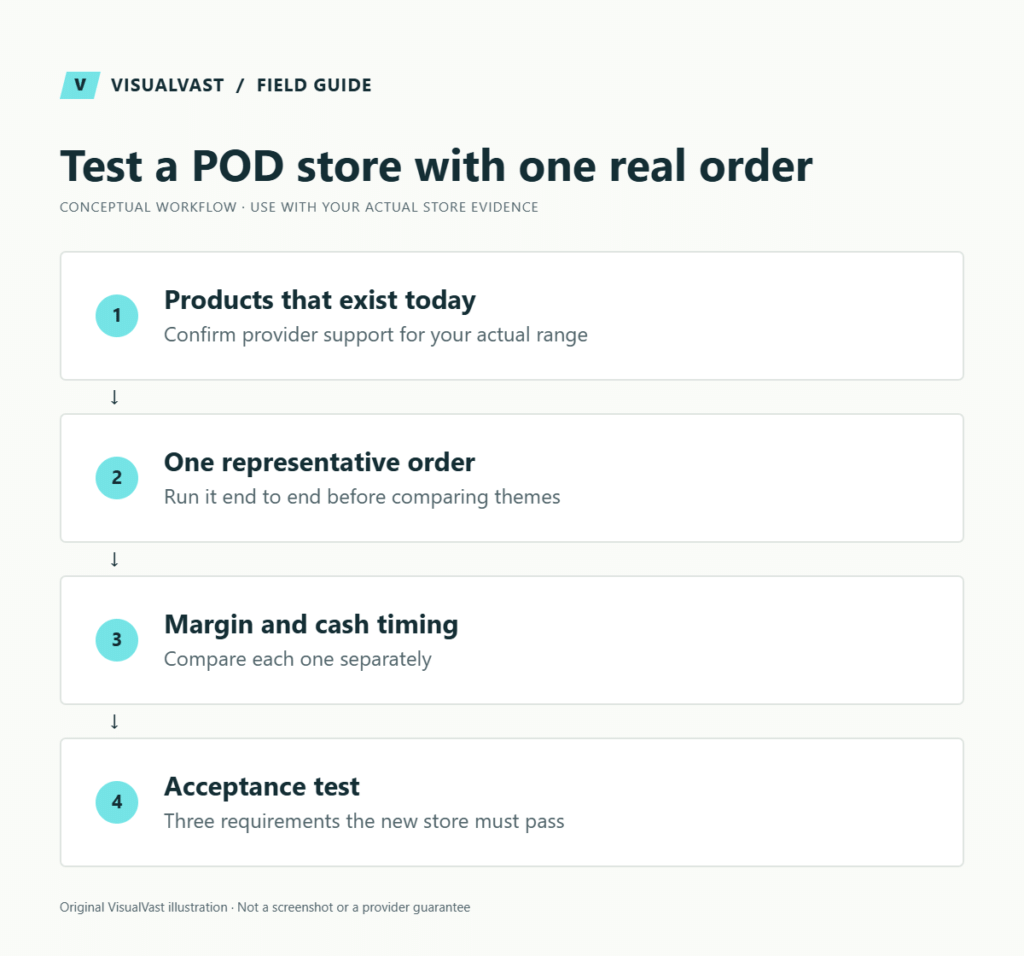
The practical comparison
| Need | OpoShop evaluation | WooCommerce evaluation |
|---|---|---|
| A focused POD storefront | Test the built-in workflow with your provider | Test the chosen provider connection and theme |
| Several fulfillment sources | Confirm actual supported routing | Prove routing and mixed-cart shipping together |
| POD plus stocked goods or downloads | Demonstrate your exact combination | Configure and test each product and shipping type |
| A content-led acquisition plan | Test the required publishing and URL controls | Plan content, store structure and editorial ownership |
| Limited technical time | Check what the service handles and excludes | Assign maintenance before launch |
Start with our platform decision hub if Shopify, Sellfy or a creator-merch model is also on your shortlist.
Verify the product that exists today
OpoShop is the successor name to EverBee Store, as explained in the official help collection. Its current website promotes a POD storefront with email, upsells, reviews and automations. At our October 20, 2026 check, its integration section listed Printify and ShineOn while marking Printful “coming soon.” Treat a roadmap label as unavailable until the live integration is confirmed for your account.
That distinction can decide the shortlist before visual design begins. If your business requires Printful today, obtain current confirmation and perform an end-to-end test. Confirm each product, region, personalization option and order-status behavior you need; a provider logo covers only the connection.
Build one representative order before comparing themes
Use a product with real complexity: several sizes, more than one color and a destination that changes shipping cost. Record the SKU at the storefront and provider, the charged shipping amount, order arrival, production approval and tracking return. Use authorized test methods and prevent unintended production charges.
Then add the hardest realistic combination. For example, a mug from one source and an item you ship yourself expose different issues from a single shirt. Work through POD and own-product shipping before deciding that either platform is simpler.
If the provider itself is undecided, use the Printful vs Printify guide to separate fulfillment selection from storefront selection. Changing both simultaneously makes the cause of problems harder to identify.
When OpoShop may be the better fit
Consider it when the supported provider workflow matches your range, the bundled features replace tools you would actually use and the team benefits from a narrower operating setup. A small validated catalog can be more valuable than a highly customizable store nobody has time to run.
Before committing, ask for a demonstration of the specific exception that matters to you: address corrections, cancellation before production, personalization review or a failed order import. Record support responsibility and the available export format. We have not performed a hands-on OpoShop fulfillment test; use these as evaluation steps.
When WooCommerce is worth investigating
A growing business might need a mixed catalog, content organized around multiple buyer groups, custom product logic or a specific operational integration. Those are possible reasons to investigate WooCommerce. They mark requirements to test: check the available options first and compare the full implementation cost.
Use the multichannel SKU plan so a product is identifiable across Etsy, the new store and fulfillment. Do not assume that adding WooCommerce creates inventory synchronization. Choose a source of truth and document which system is allowed to change each field.
Compare margin and cash timing separately
Estimate subscriptions, add-ons, payment processing, production, shipping, replacements and staff time using your own quotes. A bundle is valuable only if it replaces real spending or work. Conversely, a low software bill can hide costly manual order handling.
Use the POD cash-flow calculator to test whether production charges arrive before usable customer funds. The cash-flow planning guide explains why a profitable order can still create a short-term funding gap. That gap stays the same whichever storefront you choose, so fund it before launch.
Moving from Etsy or an existing OpoShop store
- Preserve the original design files, mockups and rights records.
- Map listing options to product variations and provider SKUs; use the Etsy variation guide for structural differences.
- Confirm which product, customer and order fields can actually be exported from the source.
- Keep open orders and returns with a named owner during cutover.
- Treat subscriptions, saved payment details and marketing permissions as separate migration work.
- Map URLs you control, analytics events and campaign destinations.
- Test fulfillment, tracking, email, refunds and a mixed cart before redirecting traffic.
Marketplace discovery, reviews and customer permissions stay with Etsy when a listing moves. Our Etsy and WooCommerce channel guide explains how to assign each channel a role. Start with a manageable catalog of your strongest listings.
Decide with an acceptance test
Write down the three requirements the new store must pass and one condition that would make you stay. Give each requirement a pass condition: the correct variant reaches the provider, checkout charges the agreed shipping, and tracking returns to the buyer. Save the test order reference and name the person who will resolve failures. If OpoShop meets them with less operating work, choosing it can be sensible. If WooCommerce proves a necessary workflow and has a maintenance owner, plan a scoped WooCommerce launch.
For unresolved routing and provider dependencies, begin with an Owned Store Readiness Audit. Once the platform is chosen, Multichannel & POD implementation can focus on the tested order flow.
Readiness Audit
Plan the build before you pay for it
The Owned Store Readiness Audit reviews your catalog, operations, budget and route to customers. You get written findings, a 45-minute walkthrough and a clear call: build now, start smaller or fix the gaps first. $349 USD.