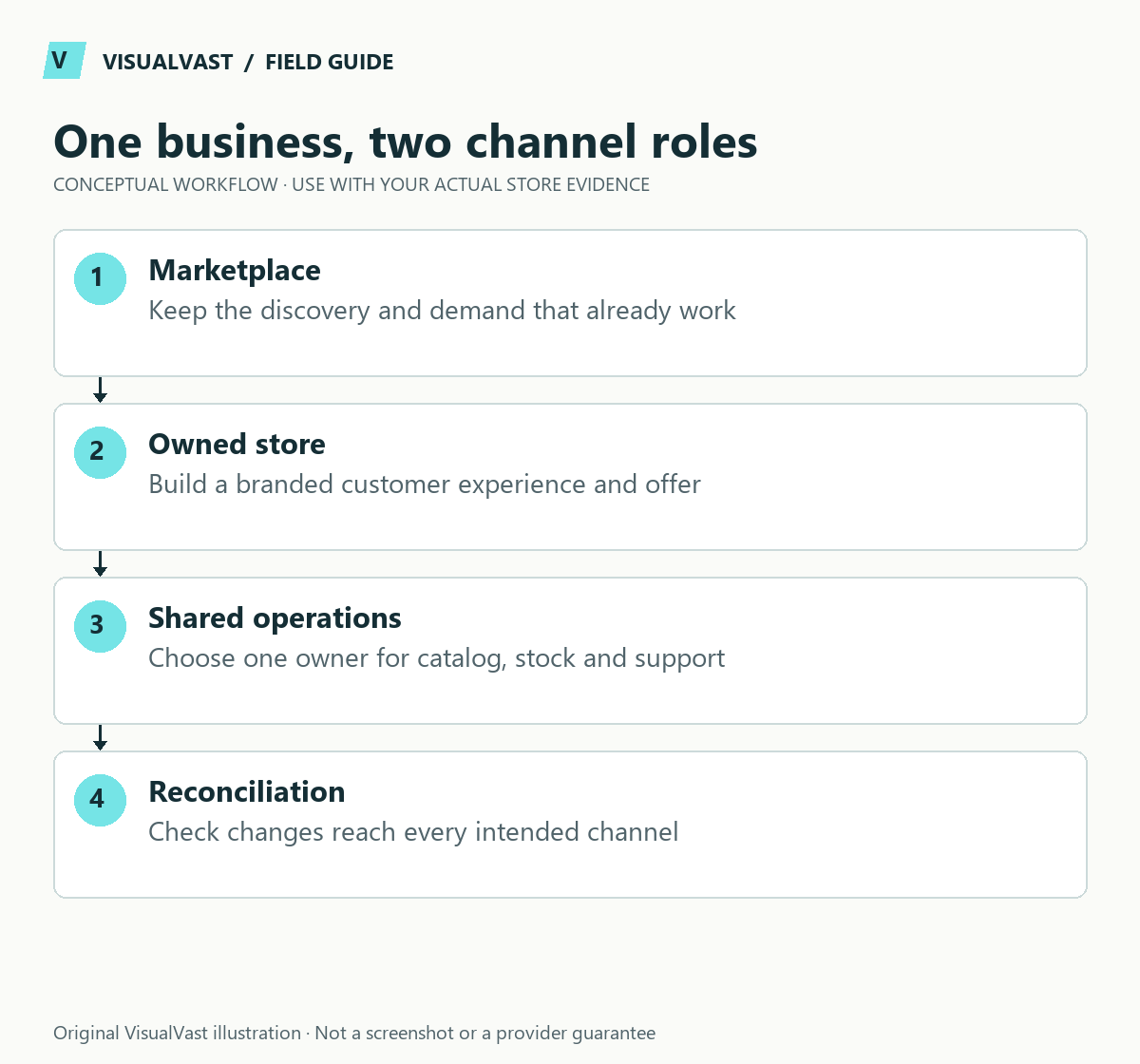
Etsy and WooCommerce can serve different roles in the same business: a marketplace shop and an independently operated storefront. Adding the second channel requires its own acquisition and operating plan. It does not require closing a marketplace channel that is working.
Decide which system wins before choosing a connector
There are three useful operating models. In a Woo-led setup, the owned store controls agreed catalog fields. In a marketplace-led setup, Etsy remains the editing starting point for selected fields. In an external inventory-led setup, a separate inventory system controls stock across channels. These are planning models, not features every connector provides.
Use this guide’s worksheet in the fillable workbook (PDF, page 4). Download and save a copy to retain your entries.
Use the owned store readiness assessment
| Field | Example owner | Direction to validate | Failure rule |
|---|---|---|---|
| Variant identity | Stable SKU register | Register to mapped listings | Stop new mapping when identifiers conflict |
| Available stock | Chosen stock ledger | Ledger to selling channels | Reconcile before increasing availability |
| Price | Channel-specific pricing plan | One agreed route per channel | Do not overwrite a deliberate channel price |
| Product copy | Each channel editor | Usually independent | Preserve useful channel-specific information |
| POD mapping | Provider and connector identifiers | Confirm supported behavior | Hold affected fulfillment until mapping is checked |
| Tracking | Fulfillment provider | Provider to customer-facing order | Investigate missing acknowledgements |
A connector may support only some of these routes. The WooCommerce Etsy integration documentation describes identifier-based mapping for that particular extension; it is not a promise about every Etsy connector.
Complete the SKU architecture before importing. Then separate the one-time catalog transfer from ongoing sync. If product descriptions overlap, read the duplicate-description explanation before paying for unnecessary rewrites.
The first question is what the owned store should make possible. A different buying experience, a clearer product library or a direct channel for independently acquired customers is a more useful objective than simply “escape fees.” You take on additional work when you operate another storefront.
Keep the marketplace policy boundary clear
Etsy prohibits directing Etsy-initiated transactions off its platform. Its policy includes offers or encouragement to buy an Etsy-listed item elsewhere and using QR codes to direct users off-platform. Plan independent acquisition rather than redirecting an Etsy buyer to avoid fees. Read Etsy’s current off-platform transactions policy before changing your shop communications.
Treat an exported order email as transaction data, not automatic permission to send marketing. Decide what you may use, why, and with what consent before importing customer information. Keep customer-data migration separate from product-data preparation and get advice where the applicable requirements are unclear.
Give each channel a job
| Decision | Etsy shop | Owned WooCommerce store |
|---|---|---|
| Discovery | Work within the marketplace’s search and selling rules | Define your own search, content, referral or advertising plan |
| Product presentation | Use the available listing structure | Build the product structure your catalog requires |
| Operations | Maintain marketplace order and service obligations | Own the website, payment, delivery and support workflow |
| Measurement | Review the shop’s available reports | Define and test your store’s measurement plan |
This is a planning comparison, not a claim that one channel always costs less or converts better. Evaluate the whole operation: software, maintenance, time, acquisition and support, as well as transaction charges.
Launch a deliberate catalog subset
You do not need to copy every product on day one. Choose a coherent range with complete assets, a clear delivery process and manageable variations. Document which products appear on each channel, whether prices differ and who maintains the records.
A fictional shop with forty designs might launch one ten-design collection on its owned store. That reduces the first round of image preparation, variant checks and support documentation. It is an illustration of scope control, not a universally optimal catalog size.
The Etsy-to-WooCommerce catalog guide explains how to separate exported fields from the decisions that still require review. Do not assume a product CSV migrates reviews, download entitlements, customers or order history.
Write the operating rules before buying a connector
List the source of truth for each field: SKU, stock, price, description, images, order status and tracking. “Sync everything” is not a specification. State the direction, expected delay, unsupported cases and what happens when a connection fails.
- Who notices an order that does not reach the fulfillment provider?
- Which system reduces shared stock when two channels sell at once?
- How are refunds and cancellations handled after production begins?
- Who can edit product identifiers, and how is the change recorded?
Use the inventory and SKU workflow to turn those questions into a testable handover. A low-volume store may initially use a documented manual process if it can maintain accurate availability; a connector is justified by requirements, not by the number of logos on a sales page.
Build traffic independently
Start with one acquisition hypothesis and one destination. For example, an original tutorial distributed through your own channels can lead to a relevant product or category. Measure meaningful visits and completed customer actions. Do not assume a new domain inherits marketplace visibility or buyer trust.
Common questions
Must the products be different on each store?
Not necessarily. The range can overlap, but pricing, availability and fulfillment must be maintained accurately. The acquisition plan and marketplace-policy boundary still need attention.
Will an integration move everything automatically?
Only supported data and actions can transfer, and the exact behavior depends on the connector and configuration. Request a field map and a representative test before relying on it.
If you want an owned channel without disrupting the business you already have, start with an Owned Store Readiness Audit and an explicit channel plan.
Continue with the next relevant check
- Owned Store Readiness Checklist: Are You Ready for WooCommerce?
- Etsy to WooCommerce: Prepare Your Product Catalog Before Importing
- Multichannel Inventory and SKUs: Define What Syncs Before Connecting
- WooCommerce SEO Migration Checklist: Protect Valuable URLs
- Can You Use the Same Product Descriptions on Etsy and Your Website?
Choose the platform for your second channel
Before committing to the second store, compare Shopify and WooCommerce for Etsy sellers. For a focused POD operation, also evaluate OpoShop and WooCommerce against your actual provider and order flow.
Keeping Etsy does not rule out a migration project. Our WooCommerce Migration service can prepare an agreed catalog for your owned store while Etsy remains active. Ongoing stock and order synchronization is a separate multichannel implementation; define that requirement during the readiness audit.