A multichannel inventory plan starts with stable product identifiers and one authoritative owner for each kind of data. Decide what moves, in which direction, and what happens when it fails. “Real-time sync” is not a complete specification for a store that depends on accurate availability.
Build stable variant identities, not just attractive SKU labels
VisualVast’s illustrative convention ART-DESIGN-SIZE-FRAME is a recommendation, not a platform rule. ART-FERN-A3-OAK identifies a different sellable variant from ART-FERN-A3-BLK. The parent product can have its own SKU, but each stock-managed child needs unambiguous mapping.
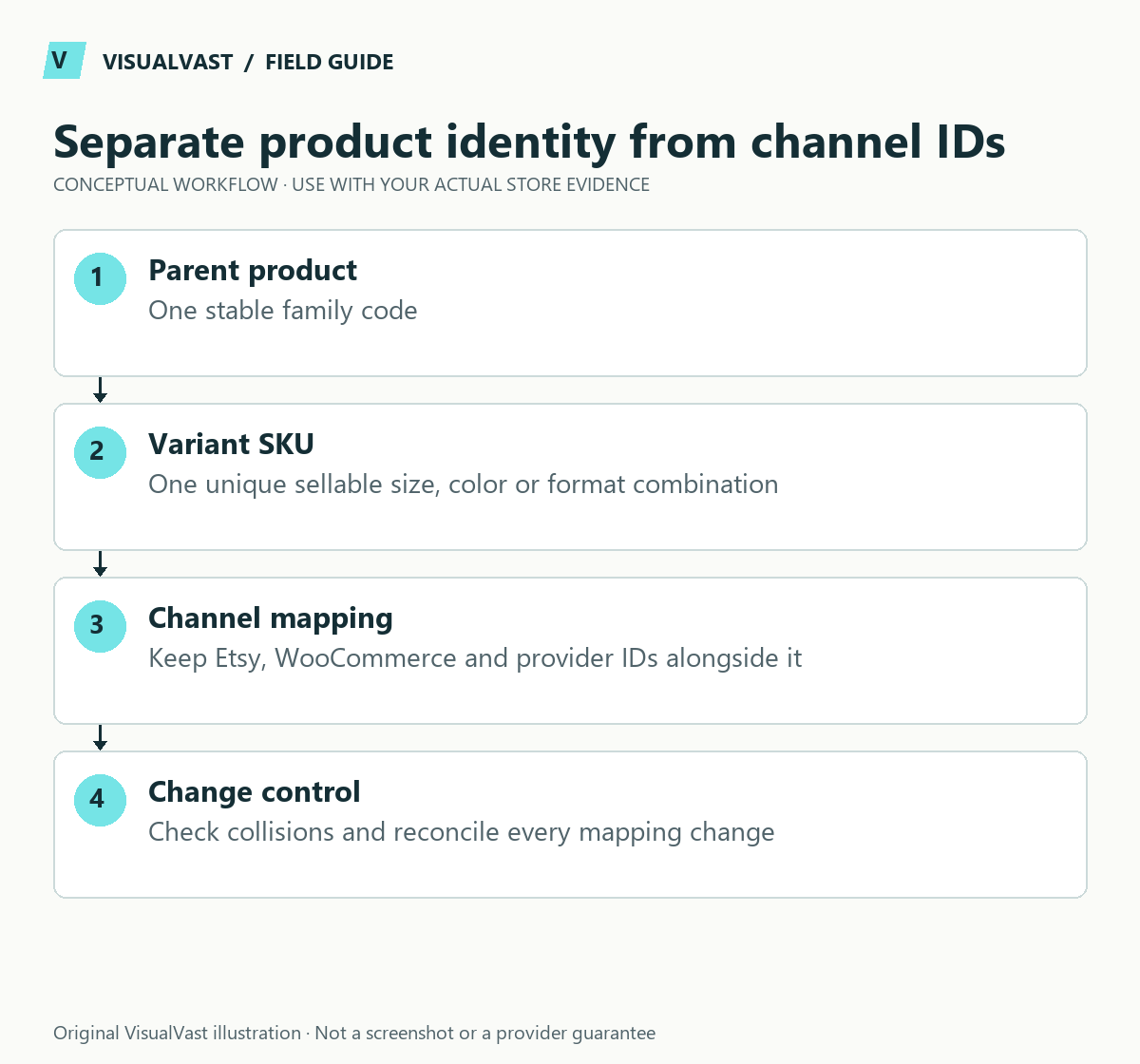
Use this guide’s worksheet in the fillable workbook (PDF, page 13). Download and save a copy to retain your entries.
Use the sku builder & collision checker
Download: Fictional six-variant SKU register (planning only) (CSV)
| Identity | Example | Purpose |
|---|---|---|
| Parent SKU | ART-FERN | Groups the design family |
| Variant SKU | ART-FERN-A3-OAK | Identifies the sellable option |
| Marketplace listing ID | Separate exported identifier | Maps the Etsy record |
| Provider variant ID | Separate provider identifier | Routes production |
Human-readable SKUs help operators; opaque codes can also work if the mapping register is dependable. Avoid embedding a temporary price, promotion or supplier name that forces an identity change later. Duplicate channel listings may represent the same physical stock unit, so document the relationship rather than inventing extra inventory.
Before changing a live SKU, export mappings and list every dependent connector. Pilot the change and verify old orders, new orders, stock and fulfillment. Review the channel ownership model and variation example. If stock looks wrong, diagnose order-status effects before manually increasing quantities.
The same product can have different internal IDs in WooCommerce, a marketplace and a fulfillment provider. Your mapping must identify the sellable variant, not merely a similar product title.
Give each sellable option a stable identity
Create a consistent SKU convention that your team can maintain. A fictional apparel SKU such as TEE-OCEAN-M can be useful if it uniquely identifies the intended item. Avoid embedding information likely to change, such as a temporary selling price. Keep old identifiers in a mapping record when changing them is unavoidable.
WooCommerce variations support their own stock and product details; review the variation guide when deciding the product structure. Verify whether a connector matches by SKU, internal ID or another field. Never assume two systems use the same matching rule.
Assign ownership field by field
| Field | Authoritative owner | Permitted direction | Failure question |
|---|---|---|---|
| Physical stock | Your chosen inventory record | Defined destinations only | Who stops overselling if updates fail? |
| Product copy | Your chosen catalog workspace | Approved publishing route | Can a channel edit overwrite the master? |
| Price | Named pricing owner | Explicit channel rules | How are differing prices preserved? |
| Order status | The system responsible for that stage | Supported status transitions | What if payment and fulfillment disagree? |
| Tracking | Fulfillment source | Customer-facing systems | Who handles missing tracking? |
Fill this table with actual system names and owners. A row labeled “both” should trigger a discussion about conflicts. Two-way editing without rules can undo valid changes.
Define the meaning of available stock
Physical quantity, available quantity and reserved quantity can differ. Decide how pending orders, damaged goods, returns and offline sales affect availability. If a retail counter and website share stock, identify when the counter sale becomes visible to the online channel.
A safety buffer may be appropriate for a particular operation, but it is not a substitute for diagnosing unreliable updates. Choose the buffer from your actual sales pace and update behavior, then revisit it. Do not apply a universal percentage without evidence.
Test the cases that expose weak assumptions
- Two channels sell the last available unit close together.
- A variation is renamed or its SKU is accidentally duplicated.
- An order is cancelled before fulfillment and after fulfillment begins.
- The connector temporarily loses access.
- A previously unavailable item returns to stock.
- A partial refund occurs without a physical return.
Write the expected state in each system and the person who reconciles mismatches. Use controlled staging or provider test workflows. Prevent test records from triggering real production or customer messages.
Decide whether automation is justified yet
A small catalog with infrequent sales may be manageable with a documented manual process and conservative availability. A high-change catalog may need more automation. The decision depends on actual workload, risk and supported connector behavior rather than a preference for fewer clicks.
For a fictional shop launching ten online items while selling locally, daily manual reconciliation might be too slow if the last unit is frequently sold at the counter. The evidence to gather is the delay between sales and availability updates. That tells you more than a generic feature list.
Common questions
Does a product import create synchronization?
No. An import loads or updates data at a point in time. Continuing stock and order updates require their own supported workflow. See the catalog preparation guide for the distinction.
Is one system always the master for everything?
Not necessarily. Stock, product content and fulfillment may have different owners. What matters is that each field has an explicit rule and the handover explains it.
The Multichannel & POD Implementation service can turn these decisions into a field map, connection scope and exception test plan.