Choose between Printful and Printify by testing the products, destinations and workflows your store needs. There is no useful universal winner without that context. A comparison should use the same product specification, shipping destination, quality criteria and operating assumptions on both sides.
Compare providers with the same operational test
Use the same design, comparable product, destination and service level wherever possible. Record sample quality separately from shipping configuration and integration reliability. A better sample from one provider does not prove that its WooCommerce rate behavior fits your mixed store.
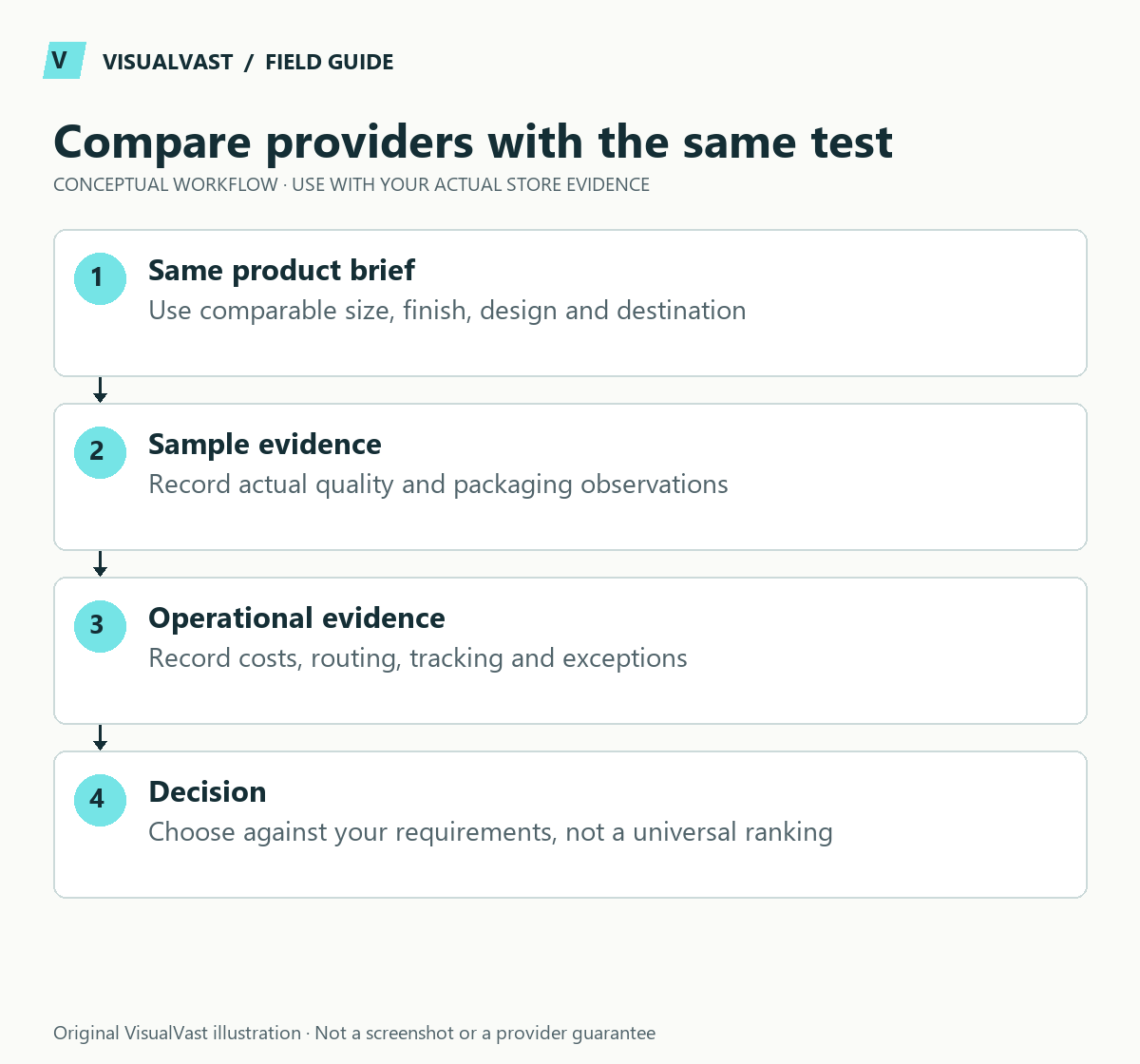
Use this guide’s worksheet in the fillable workbook (PDF, page 12). Download and save a copy to retain your entries.
Use the pod cash-flow calculator
| Comparison | Record |
|---|---|
| Delivered cost | Product, print areas, shipping and applicable charges |
| Funding timing | When production is charged versus payout availability |
| Mapping | Product, variant and provider identifiers |
| Shipping | POD-only and mixed-cart behavior |
| Exceptions | Missing order, unavailable variant and support route |
Use current provider documentation for settings and prices; do not call either provider universally cheapest or best. The mixed-shipping test guide explains why provider rules need separate validation. Use the cash-flow scenarios before assuming a profitable order is immediately affordable.
Label future hands-on evidence honestly: tested date, exact product and destination, number of samples, and limitations. Until those tests exist, this is an evaluation framework, not a tested product review or endorsement.
This is a selection worksheet, not a hands-on product review or a claim that VisualVast has tested every provider. It deliberately avoids static price tables that can become inaccurate when products, plans or shipping rates change.
Define an identical comparison basket
Pick representative products and variations. Record garment or item specification, print area, artwork, quantity and destination. If the exact item differs between services, note the difference rather than presenting the prices as equivalent.
Calculate the cost delivered to the customer using current provider information, then include other costs your business bears. Consider the time needed to maintain products and resolve problems. A lower supplier price is not automatically a better customer experience or a higher net return.
| Criterion | Evidence to collect | Decision question |
|---|---|---|
| Product fit | Catalog specification and available options | Does it support the actual collection? |
| Quality | Your representative samples and dated notes | Can you make the claims on your product page? |
| Delivery | Destination-specific estimates and observed sample journey | Can you explain production and shipping honestly? |
| Workflow | Connection, approval, tracking and exception tests | Can the team operate it without guesswork? |
| Change risk | Substitution, availability and escalation process | What happens when the original route is unavailable? |
Verify the WooCommerce connection separately
Printify’s WooCommerce connection guide describes its store connection and shipping-plugin steps. Follow current provider instructions for your installed setup and check compatibility before granting access. Do not change a live store’s URLs casually to satisfy a setup example.
For either service, record the permissions requested, the account owner and the way to revoke the connection. A connection test should include a product, a supported variation, an order and a status update. An authorization success message does not verify all four.
Compare money movement and approval controls
Printful explains that the customer pays the store while the provider charges the merchant for fulfillment; customer refunds are also the merchant’s responsibility. See its payment and refund explanation. Printify documents manual and automatic approval choices.
The selection question is how these workflows fit your capacity. Who reviews an address change? How is a supplier charge reconciled with an order? What happens if the provider cannot process the request? Check the current answer in each account rather than treating either service’s workflow as interchangeable.
Run the same practical evaluation
- Order representative samples through an explicitly approved purchase process.
- Record product quality and packaging against criteria decided in advance.
- Review delivery communication from the buyer’s perspective.
- Test non-production order routing in a controlled store.
- Ask each provider how it handles the exceptions important to your catalog.
- Document unresolved limitations before choosing the initial integration.
Use evidence labels: observed, documented by provider, or not yet tested. This prevents a marketing claim from accidentally becoming a verified result in your decision sheet. If you have only researched the services, say so when publishing your own comparison.
Choose for the first launch, then reassess
A fictional brand serving one region with a narrow collection might prioritize consistent samples and a simple support path over catalog breadth. Another brand may need a different product family or regional coverage. The right criteria come from the offer, not a generic ranking.
Avoid connecting multiple providers just to keep every option open. More routes can mean more shipping combinations, support rules and stock exceptions. Add a second provider when the need and operating plan are clear.
Common questions
Which provider is always cheaper?
This worksheet does not establish one. Compare current costs for the same specifications and destinations, including the operating costs that sit outside the supplier quote.
Can I change providers later?
Potentially, but product mappings, samples, artwork specifications, delivery copy and order handling need review. Treat the change as a controlled migration, not a cosmetic switch.
Use the POD launch checklist to turn your choice into tests, or explore Multichannel & POD Implementation for a scoped workflow.
Continue with the next relevant check
- WooCommerce POD Launch Checklist: Products, Orders and Fulfillment
- POD and Your Own Products in WooCommerce: Test Mixed Shipping
- Printify Order Not Showing From WooCommerce? Check These in Order
- POD Cash Flow: Estimate the Gap Between Production Charges and Payouts
Separate the provider and storefront decisions
A suitable provider still needs a supported storefront connection. The OpoShop vs WooCommerce guide explains how to distinguish current integrations from roadmap claims and test the actual order route.