Before changing the design or buying more traffic, identify where the customer journey stops. No sales can reflect almost no qualified visitors, an unclear offer, a checkout failure or incomplete measurement. Those situations need different actions, and a small sample may not support a confident conclusion yet.
Start by comparing actual WooCommerce orders with the analytics record. A real order absent from analytics is a measurement problem, even if the store also needs better traffic. Conversely, a duplicated purchase event can make performance look healthier than it is.
Validate the measurement first
Google’s ecommerce setup guidance describes events such as view_item, add_to_cart, begin_checkout and purchase. Having an analytics tag does not prove those ecommerce events or their parameters are correct. Use an authorized test workflow and inspect one known transaction without exposing customer details.
Keep event, item and user counts distinct. Google explains their differences in its ecommerce metrics reference. Compare like-for-like periods, product groups and traffic sources before dividing one count by another.
Locate the earliest weak stage
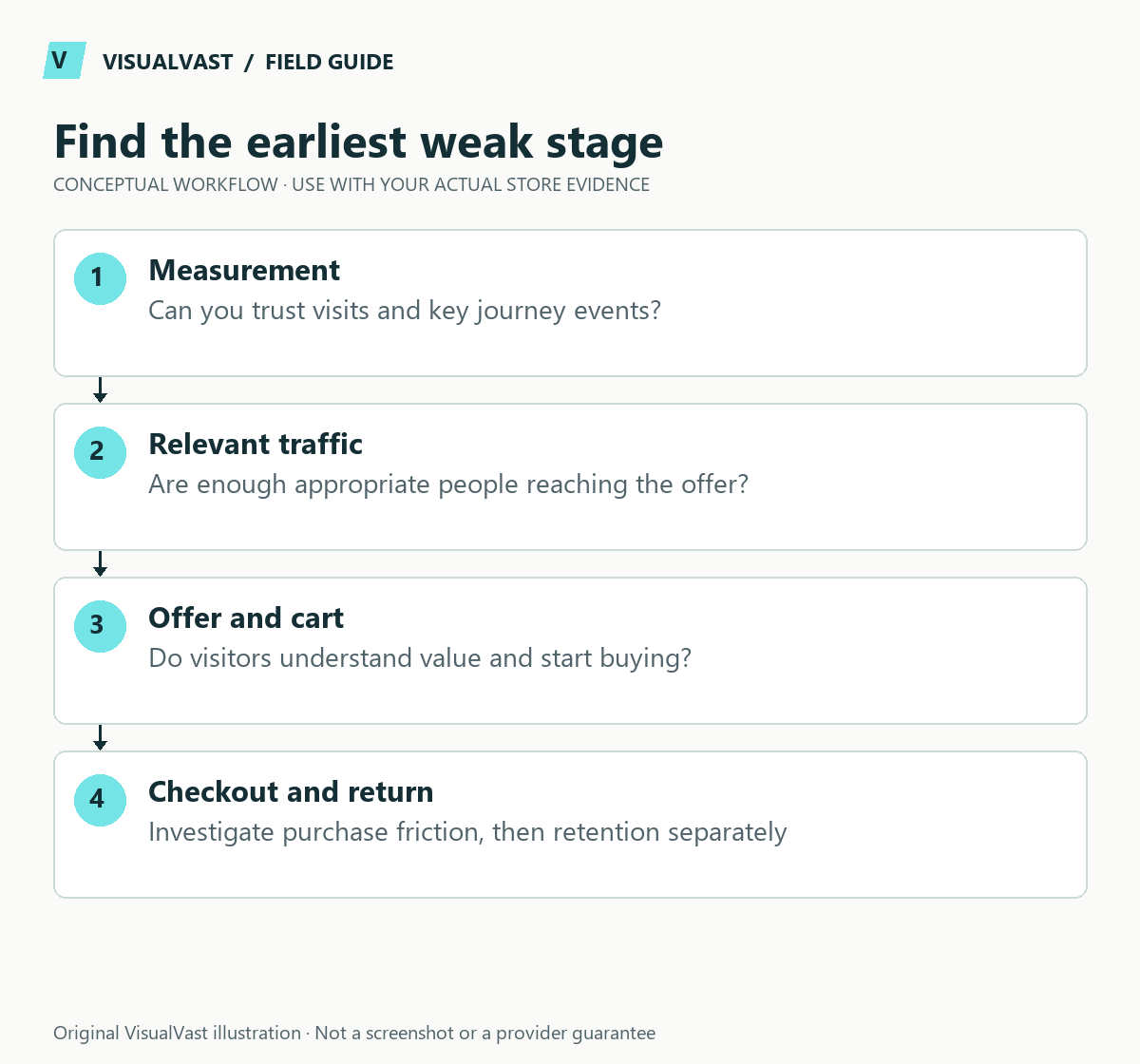
Use this guide’s worksheet in the fillable workbook (PDF, page 34). Download and save a copy to retain your entries.
Use the store traffic & conversion diagnosis
Download: Traffic experiment and measurement log (CSV)
| Evidence | First investigation | Avoid concluding |
|---|---|---|
| Very few Search Console impressions | Indexing eligibility, query relevance and discoverability | The checkout is the main problem |
| Impressions without useful clicks | Query intent and search presentation | Every impression represents a likely buyer |
| Visits without product engagement | Landing-page relevance and audience fit | More traffic alone will solve it |
| Product engagement without carts | Offer clarity, price context and product constraints | One universal conversion benchmark applies |
| Carts without checkout starts | Unexpected costs, delivery conditions and trust questions | All abandoned carts are recoverable sales |
| Checkout starts without completed orders | Payment, shipping and usability checks | It is only a copywriting problem |
These are starting hypotheses, not automatic diagnoses. Search Console covers Google Search visibility, not every acquisition channel. Analytics can be incomplete because of consent, blockers or implementation gaps. Customer conversations and support reports add context.
Investigate one hypothesis at a time
If the store has only a handful of visits, collect more qualified evidence before interpreting tiny percentage changes. If a specific payment or shipping error reproduces, fix that operational issue before spending to send more people into it. Use the checkout test plan for that branch.
If visitors cannot tell what they receive, use the product description guide and digital product-page checklist. If the problem is product-feed consistency, follow the Merchant Center audit rather than rewriting every page.
Turn the diagnosis into an experiment
Choose one change, its intended effect, the evidence to observe and a review date. For example, a fictional store might clarify whether a print includes a frame, then monitor product questions and qualified cart activity. Do not attribute any subsequent sales change to that edit without considering traffic mix, promotions and small-sample variation.
Keep the experiment log in the 90-day traffic plan. New founders can return to the first-offer validation guide if the audience or offer is still uncertain.
SEO & Traffic Foundations can scope measurement, architecture and acquisition priorities. The purpose of this diagnosis is to select the next useful action, not to promise rankings, a standard conversion rate or automatic sales.