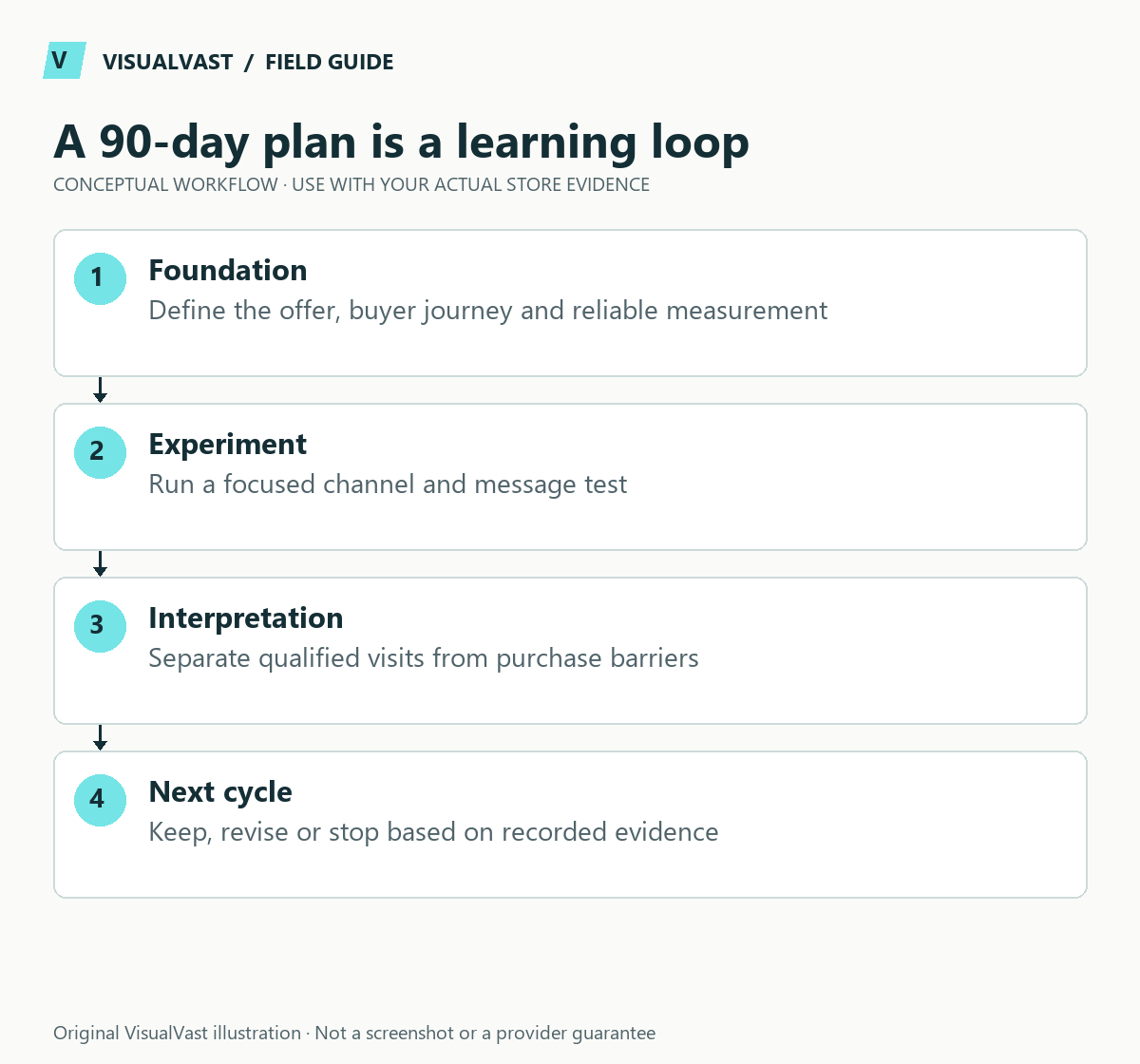
A new store’s traffic plan should connect one audience, a useful offer, a small number of acquisition experiments and a measurement routine. Use the first ninety days to learn which messages and destinations attract qualified interest. Treat the schedule as a working plan, not a promise of sales by a deadline.
Diagnose the bottleneck before choosing the next 30-day activity
No sales can mean insufficient qualified visits, an unclear offer, a broken checkout or unreliable measurement. Those require different responses. Start with the traffic-versus-conversion diagnostic and verify the tracking against a known order before judging the funnel.
For the first month, choose one customer problem and one plausible distribution route. In the second, improve the landing page or product explanation indicated by evidence. In the third, repeat what produces qualified actions and stop work whose assumptions failed. Time periods are review windows, not promised ranking milestones.
Google free listings may be a relevant additional route for eligible products, but they require accurate product data and policy compliance. Use the Merchant Center consistency audit before treating a feed as finished. Do not count impressions, sessions and purchasers as interchangeable measures.
When data is sparse, record qualitative buyer questions alongside small counts. A handful of visits cannot support confident claims that a design change increased conversion. The goal is a better next decision, not a dashboard that looks busy.
Start by defining the action that matters: a relevant enquiry, a product view followed by a purchase, or an appropriately consented signup. Raw visits alone cannot tell you whether the store is reaching the right people.
Days 1–30: establish the foundation
Finish the product pages and navigation before sending people to them. Clarify the offer, delivery, support and important limitations. Verify the buying journey and configure measurement around the actual customer actions and applicable privacy choices.
Choose one main discovery route you can sustain. Search-led guides, useful demonstrations, relevant partnerships or a bounded advertising test may fit different businesses. Avoid launching five channels that nobody has time to maintain.
Write a short baseline: current relevant visits, enquiries, orders and known measurement gaps. Where there is no history, record zero or unknown honestly. Do not invent a benchmark from another business to make the plan appear more certain.
Days 31–60: run focused experiments
Use this guide’s worksheet in the fillable workbook (PDF, page 21). Download and save a copy to retain your entries.
Use the store traffic & conversion diagnosis
Download: Traffic experiment and measurement log (CSV)
| Experiment | Destination | Learning question | Review action |
|---|---|---|---|
| Answer a recurring buyer question | A relevant guide and next step | Does the topic attract the intended audience? | Improve the answer or distribution |
| Demonstrate a product | The matching product page | Do people understand the use and limits? | Address recurring objections |
| Collaborate with a relevant partner | A clearly matched landing page | Is the audience a useful fit? | Continue only with evidence |
| Test paid distribution if appropriate | A tested offer page | What does qualified attention cost? | Review against a pre-agreed limit |
Use consistent campaign labels and record the dates of changes. Change one major variable at a time where practical. If both the offer and channel change together, it becomes harder to explain the result.
Days 61–90: improve what shows useful signals
Review landing-page behavior alongside the quality of customer questions. A guide with modest traffic but relevant enquiries may deserve more attention than a high-traffic tutorial aimed at an unrelated audience. Expand topics only when they serve the business’s actual buyers.
Update the product page where repeated confusion appears. Strengthen internal links where readers cannot find the next useful step. Retire an experiment when its assumptions fail rather than continuing because time has already been invested.
Build for search and AI discovery with the same useful content
Google says ordinary SEO practices apply to its AI search features; there is no special AI schema requirement. Eligible pages need to be indexed and available for snippets, but inclusion is not guaranteed. See Google’s AI-feature guidance.
The practical editorial approach is to answer a defined question directly, support factual claims, explain examples and limitations, and keep the content accessible as text. This helps readers assess the answer and gives retrieval systems clear material to interpret. It is not a way to force a model to recommend a business.
Measure decisions, not just visibility
- Track qualified enquiries or orders by landing page where the data supports it.
- Separate branded and non-branded search trends when available.
- Note important attribution gaps and consent effects.
- Inspect referral traffic from AI services without assuming all AI influence is visible.
- Keep a recurring list of customer questions to guide the next articles.
Use a weekly operational review and a monthly strategic review as a starting cadence. The right schedule depends on available data and capacity. Small samples require caution; one conversion is not a stable conversion rate.
Common questions
Should I publish every day?
Only if the team can produce and maintain useful, distinct material. A smaller set of complete guides is preferable to repetitive articles with no clear audience or task.
Will this plan guarantee Google or AI citations?
No. It improves the quality and discoverability of the material you control. Rankings, citations and commercial outcomes depend on factors beyond the plan.
Explore SEO & Traffic Foundations to connect your content, site structure and measurement plan before scaling promotion.
Continue with the next relevant check
- How to Start an Ecommerce Store Without an Existing Audience
- Product Descriptions for SEO: Write for the Buying Decision
- WooCommerce Merchant Center Price and Availability Mismatches
- WooCommerce Store Has No Sales: Traffic or Conversion Problem?
Creating product demonstrations for your traffic plan? Our video tools guide for ecommerce sellers covers free watermark-free exports, Chromebook editing and a practical product-video workflow.