You can plan an ecommerce store before you have an audience, but the first job is to learn who needs the product and how you can reach them. A store makes an offer available; it does not automatically create demand. Start with one buyer problem, one small offer and one measurable learning test.
Run one demand experiment before expanding the catalog
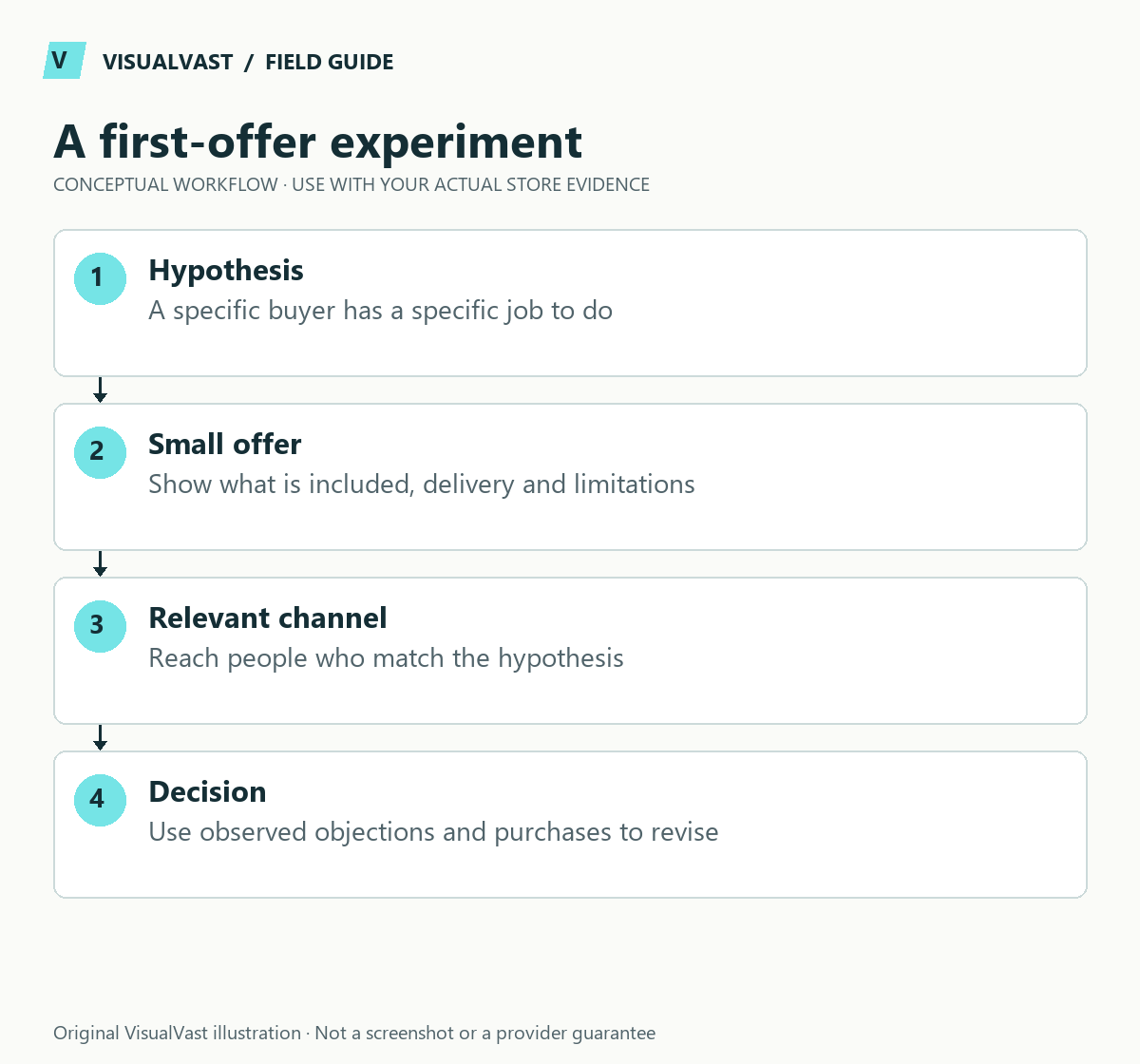
Write an experiment card with five fields: buyer, problem, offer, distribution route and decision date. Choose a signal close to purchase intent, such as a qualified enquiry about the exact product, rather than treating a social like as proof of demand. Record objections in the customer’s own words without publishing personal details.
For a first digital product, show a representative preview and the actual file requirements. For POD, inspect a sample and delivery expectations. For stocked goods, confirm replenishment and shipping costs. The experiment should test whether the offer is understandable and deliverable, not whether a large website can be built.
Decide in advance what would make you narrow, revise or pause the offer. A small sample is directional evidence; it does not justify a universal conversion benchmark. Once a site is receiving visitors, use the traffic-versus-conversion diagnosis to locate the next problem. Connect the findings to the 90-day traffic plan instead of restarting marketing every week.
This approach applies to a digital download, a POD collection or a physical product. The product and delivery risks differ, but the early question is the same: what evidence would justify the next investment of time and money?
Define the offer in ordinary language
Complete this sentence: “For [specific person] dealing with [specific situation], this product helps with [specific task], and includes [concrete deliverables].” Avoid describing the target as everyone who likes quality products. That gives you little guidance for product pages or outreach.
A fictional digital example is a weekly planning workbook for independent tutors preparing lessons and tracking appointments. A vague alternative is a productivity download for everyone. The first gives you questions to investigate: what do tutors already use, where does planning break down, and what would make another tool worth adopting?
Interview for behavior rather than praise
Ask people about the last time they faced the problem. What did they do, what took effort, and what did they already pay for? Show a sample and observe where they become confused. Ask what would prevent a purchase. Avoid relying on “Would you buy this?” as if an encouraging answer were an order.
Record notes in four columns: situation, current workaround, objection and possible product change. Do not collect more personal information than the research needs. If you want to contact participants later, explain that separately and obtain appropriate permission.
Choose a small test with a stopping rule
Use this guide’s worksheet in the fillable workbook (PDF, page 6). Download and save a copy to retain your entries.
Use the owned store readiness assessment · Use the store traffic & conversion diagnosis
Download: Traffic experiment and measurement log (CSV)
| Test | What it can teach | What it cannot prove |
|---|---|---|
| Product demonstration | Whether people understand the offer | That a wide audience will buy |
| Interest page | Which questions and objections appear | That interest equals paid demand |
| Limited launch | Whether an actual buying and delivery journey works | That the channel will scale profitably |
| Content experiment | Whether a topic attracts relevant attention | That all visits have purchase intent |
Write the duration, effort limit and decision before starting. For example: run a two-week demonstration and conversation exercise, then decide whether the recurring objections can be resolved within the planned scope. These are suggested planning parameters, not universal success thresholds.
Build only what the next test requires
An interest page may need a product explanation and a clearly described signup choice. A paid launch needs accurate product terms, payments, delivery, support and appropriate business policies. Do not take payment for something you cannot deliver on the stated terms.
For the actual store, keep the catalog narrow enough to test thoroughly. The digital, POD and physical-product comparison helps identify the operating work behind each model. The launch budget makes the continuing costs visible.
Select one route to potential customers
Start where your prospective buyers already seek help, while respecting each community’s rules. Original educational content, relevant partnerships and a small paid experiment are possibilities, not requirements. Choose a route you can sustain and a landing page that matches the promise of the message.
After launch, Google recommends registering and helping it discover a new ecommerce site; discovery is still not a guarantee of traffic. See Google’s ecommerce launch guidance. Use the 90-day traffic plan to connect preparation with ongoing work.
Common questions
Should I wait until I have thousands of followers?
Follower count alone is a weak readiness signal. A smaller group with a clear need can teach you more than a large, unrelated audience. Look for relevant behavior and practical delivery readiness.
Does validating an idea remove launch risk?
No. It reduces some uncertainty. Keep assumptions explicit, test the purchase journey and review actual customer feedback before expanding.
If you have an offer but need a realistic first-store scope, the Readiness Audit can help turn open questions into a preparation and launch plan.