An owned store is ready to build when you can describe the offer, deliver the product, support the buyer, and fund a realistic route to customers. Previous sales help, but they are not a prerequisite. A defined first offer is more useful than an ambitious list of features.
Make a go, prepare or wait decision
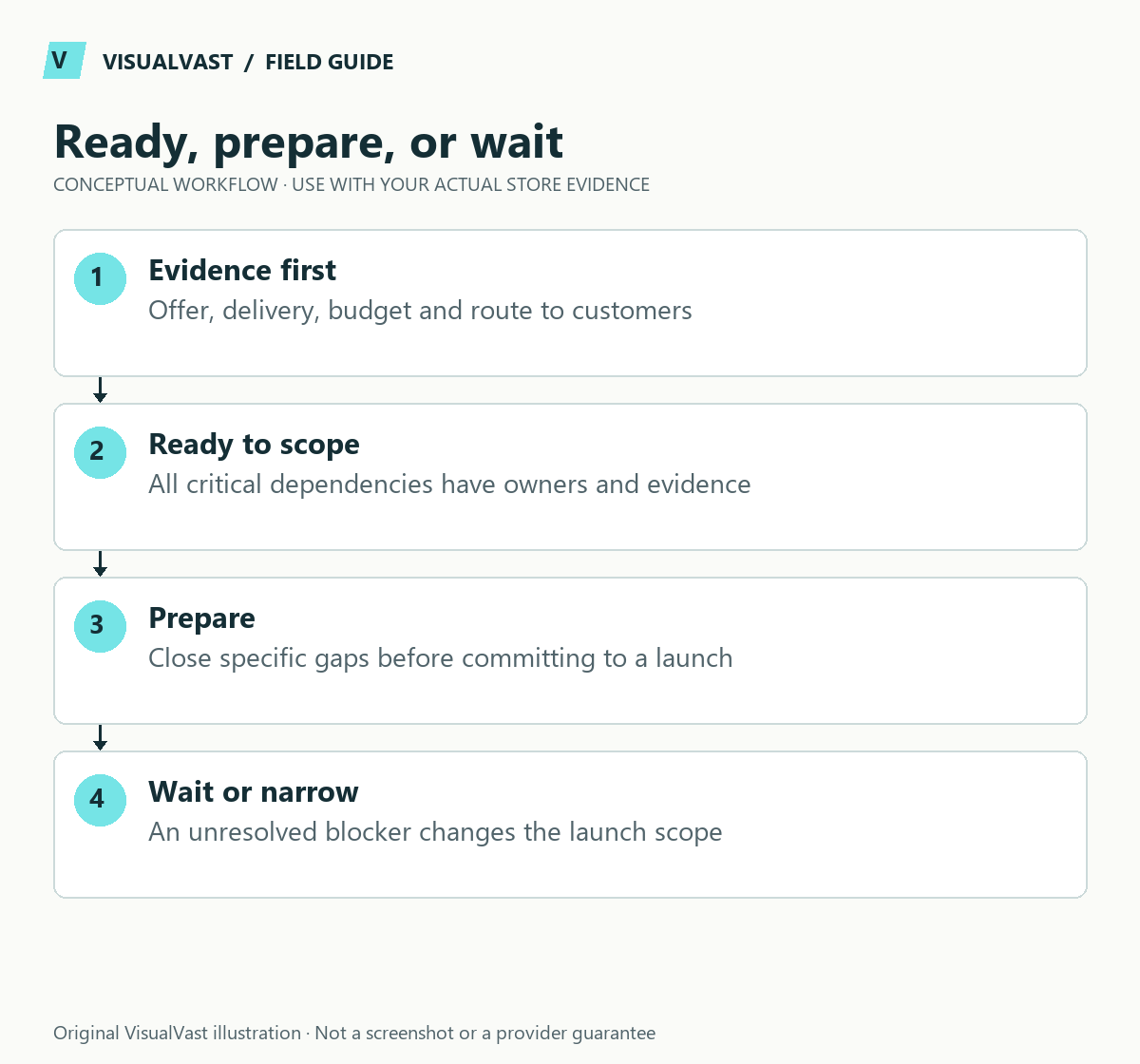
Treat readiness as a decision with blocking conditions, not a total that can hide one serious gap. A store can have excellent photographs and still be unready if nobody can deliver the order. VisualVast recommends recording evidence, an owner and a next action for each unresolved item.
Use this guide’s worksheet in the fillable workbook (PDF, page 3). Download and save a copy to retain your entries.
Use the owned store readiness assessment · Use the owned-store break-even calculator
| Decision | Use it when | Next action |
|---|---|---|
| Go with a bounded launch | Offer, delivery, payment, support and acquisition responsibilities are defined | Limit the first release to tested products and workflows |
| Prepare first | A specific dependency is unresolved but can be tested | Assign a deadline and evidence needed to resolve it |
| Wait | The build would consume the operating runway, or the product cannot yet be delivered reliably | Test the offer and cost assumptions before commissioning a store |
A new founder does not need marketplace sales to pass this review. They do need a finished deliverable, a realistic fulfillment route and a small demand test. An established seller should bring actual product and support records rather than assume marketplace success transfers automatically.
If the question is which channel should control the business data, use the Etsy and WooCommerce channel-role worksheet. If funding is the blocker, complete the launch budget and, for POD, the cash-flow exercise.
WooCommerce setup includes decisions about products, payments and store operation; completing the setup screens is only part of readiness. See the official setup guide for the platform workflow. The decision framework below is VisualVast’s planning approach, not a certification or a prediction of sales.
Check five foundations before commissioning the build
| Foundation | Evidence to gather | A reason to prepare first |
|---|---|---|
| Offer | One target buyer, product purpose, price assumptions and product boundaries | You cannot explain what the buyer receives |
| Catalog | Product names, images, variants, files and rights to use them | The range changes every time you discuss it |
| Delivery | A fulfillment or download process and exception owner | Nobody knows how to handle a failed delivery |
| Capacity | Available time, initial budget and ongoing responsibilities | The launch uses all resources before any marketing begins |
| Discovery | One plausible acquisition channel and an initial test | The plan assumes the website will generate demand by itself |
Mark each row Ready, Needs work, or Unknown. An unknown is a research task, not an automatic failure. Avoid adding the marks into a magical score: one unresolved payment or delivery dependency can matter more than several finished design decisions.
Use a different evidence standard for a first store
An established seller can bring product sales, repeated customer questions and fulfillment records. A new founder can bring interview notes, a prototype, sample feedback and a clearly bounded catalog. Do not manufacture certainty by presenting friends’ compliments as validated demand.
For example, a fictional creator planning three downloadable workbooks could start with one finished workbook and five structured conversations about the problem it solves. The useful output is a list of buying objections and a product demonstration. It is not a claim that five interviews guarantee a market. Read the first-store validation plan for a practical next step.
Separate launch requirements from later improvements
Write three lists. “Required” contains the steps a customer needs to understand, buy and receive the product. “Operational” contains what the business needs to deliver that promise. “Later” contains improvements that do not block those journeys.
- Required: accurate product pages, usable checkout, working payment method, clear delivery information and support contact.
- Operational: order handling, stock or file ownership, an exception process, backups and maintenance responsibility.
- Later: a loyalty program, elaborate animation, a large editorial archive or a connector with no present use case.
Keep legal, tax and product-compliance questions visible with a named person responsible for resolving them. A web build does not settle those questions automatically.
Make the decision explicit
Choose one of three outcomes. Build a bounded launch if the essential dependencies are understood. Prepare first if the offer, assets or operations need work. Defer if the business cannot currently support another channel. Write the reason, the evidence still missing, the next action and its owner.
A useful readiness document should fit into a working meeting. Include links to the catalog, a customer journey, an assumptions register and a short budget. Ask any prospective implementer to explain how their proposed scope addresses those items. Compare scope and responsibilities before comparing headline prices; the launch budget worksheet helps expose omitted costs.
Common questions
Do I need an Etsy shop first?
No. WooCommerce can support a first sales channel. You still need an offer, an operating plan and a way to reach potential buyers. An Etsy history is one possible source of evidence, not an entry requirement.
Is readiness the same as guaranteed profitability?
No. Readiness means the practical dependencies are understood well enough to make an informed decision. Demand, execution and changing costs can still affect results.
Turn the checklist into a scoped decision
If you need help identifying gaps, the Owned Store Readiness Audit turns your business context into a prioritized launch recommendation. Bring the unresolved questions rather than trying to make everything appear finished.
Continue with the next relevant check
- Etsy and WooCommerce: Build an Owned Store Alongside Your Shop
- WooCommerce Launch Budget: Plan the Full Cost of Your Store
- How to Start an Ecommerce Store Without an Existing Audience
- WooCommerce Maintenance and Handover Checklist for Store Owners
- WooCommerce Store Has No Sales: Traffic or Conversion Problem?
Compare platforms before committing
If platform fit is still uncertain, use the six-platform decision guide to compare the next requirement, operating responsibility and migration cost. The right readiness outcome may be to keep your current platform.