If you own or have permission to use the copy, the same product facts can appear on Etsy and your website. Ordinary duplicate content is not automatically a Google spam-policy violation. The useful question is whether the owned-store page gives buyers enough distinctive, accurate information to make a decision.
Google’s crawling and indexing FAQ distinguishes duplicate content from spam. Similar pages can still affect which version Google chooses to show, and copying text does not guarantee that your newer website will rank. Do not confuse that with a universal duplicate-content penalty.
Keep facts consistent and improve context
Dimensions, material, file format and compatibility should not change simply to make text look unique. Rewrite where the customer’s context differs. Etsy supplies marketplace branding, policies and familiar purchase conventions around a listing. Your website needs to explain its own delivery, support and buying experience.
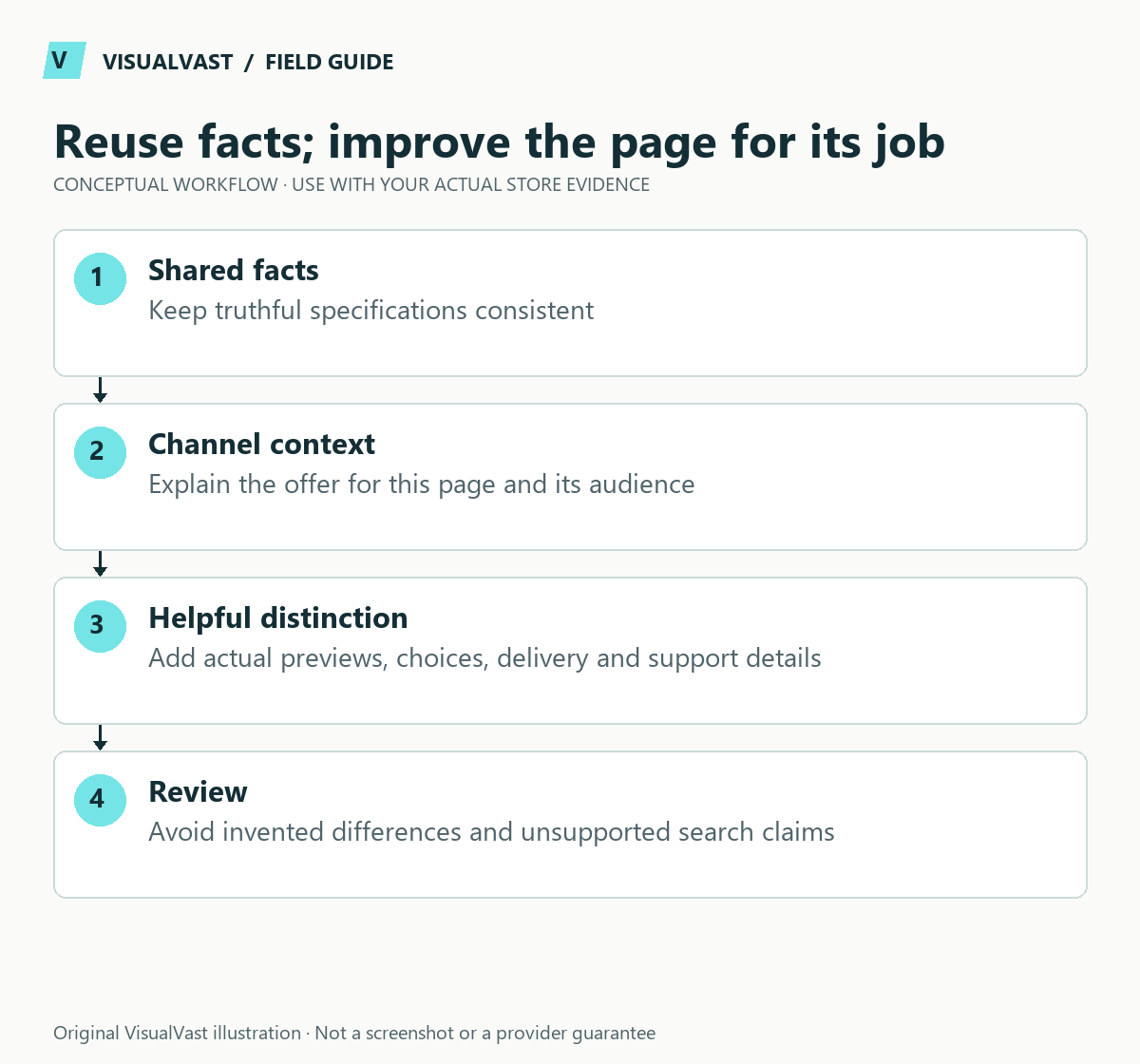
Use this guide’s worksheet in the fillable workbook (PDF, page 27). Download and save a copy to retain your entries.
| Keep consistent | Adapt for the owned store |
|---|---|
| Actual dimensions and product options | Navigation to related sizes or collections |
| Included files or physical components | Clear delivery and access instructions |
| Accurate material and compatibility | Brand-specific demonstration or usage example |
| Genuine limitations | Support route and relevant help guide |
For a digital product, connect the description to the file and access checklist. For physical products, make frame inclusion, delivery format and processing expectations explicit.
A fictional rewrite example
A weak description says: “Beautiful fern wall art, perfect for any room.” An informative version might say: “Fern illustration supplied as an unframed A3 paper print. The frame and props shown in the room mockup are not included. Choose the listed size before adding it to your cart.” Only use those statements if they describe the actual product.
The improvement is not the number of changed words. It is the reduction in uncertainty. Add original photographs, scale references or a useful demonstration when you have them. Do not manufacture reviews, certifications or results to create apparent uniqueness.
Avoid technical fixes that hide the page you want found
A canonical is a signal about a preferred URL, not a magic way to rank both versions. Do not point an owned-store page to a marketplace URL just because the descriptions overlap unless you deliberately want that canonical strategy and understand its consequences. Likewise, do not noindex valuable product pages merely to avoid ordinary repeated text.
Separate text decisions from URL decisions. Use the site-structure guide for collections and the SEO migration checklist when addresses change. The goal is a coherent store, not a set of disconnected rewrites.
Prioritize edits by buyer value
Start with products that have meaningful demand or recurring questions. Compare the page against the actual product, update unclear claims and add helpful links. Follow the product-description workflow and measure qualified engagement without promising a ranking increase from a rewrite alone.
If you need a channel-wide plan, SEO & Traffic Foundations can scope architecture, measurement and content priorities. Keep the Etsy and WooCommerce channel roles explicit so one automated sync does not overwrite useful channel-specific copy.